
NextWealth Study’s Suitability Report Bottleneck & Our Compliance Automation Software Solution

Author
Ben Glass
Published
Read time
A clear pattern is emerging in UK financial advice, and NextWealth’s December 2025 AI study captured it well:
52% of firms use AI for meeting notes
Only 8% use it for suitability reports
Yet 64% are considering suitability report automation, the biggest jump in intent across all AI functions
Meeting notes scaled quickly because the workflow was simple and low risk. Suitability reports didn’t, because the infrastructure underneath wasn’t ready.
What most commentary misses is this: what firms say they’re doing and what’s actually happening aren’t the same.
AdvisoryAI now processes around 5,000 reports per week, including roughly 500 suitability letters and 400 annual reviews. That gives us a live, unfiltered view of how advice firms are scaling under Consumer Duty pressure, and the reality is further along than surveys suggest.
NextWealth is right: suitability reporting is the standout opportunity. For consolidators and forward-thinking firms, it’s already becoming an operational reality.
Let’s look at what the research found, what live data shows, and where this is heading with compliance automation software embedded.
Why AI Adoption in Suitability Reporting Has Been Slower Than for Meeting Notes
The NextWealth AI study makes one thing clear: meeting notes were the easiest place for firms to start.
An adviser records a meeting.
AI transcribes it.
Structured notes and post-meeting emails appear minutes later.
The workflow was already clean. The value was immediate. Risk was low.
That’s why 52% of firms adopted AI for meeting notes first.
Suitability reports, despite being far more time-consuming (4–6 hours per report), haven’t followed the same trajectory. Only 8% of firms currently use AI here.
NextWealth’s research points to three consistent blockers.
1. Accuracy and logic risk
Generic AI can draft convincing text, but suitability reports demand precision. Missing disclosures, incorrect calculations, or vague rationale introduce compliance risk instead of removing it.
2. AI scales broken processes
Where templates and review standards vary by paraplanner, AI simply accelerates inconsistency. As one interviewee put it:
“If the process isn’t right, the tool will hinder you.”
3. Data integration gaps
As the report notes:
“Everything I’ve seen is good, but they miss the hard data… where’s it getting the data from?”
Without reliable extraction from illustrations, fact finds, and provider platforms, AI outputs remain partial, forcing manual rework that erodes efficiency.
Layer Consumer Duty on top of this, and hesitation is understandable. Firms are no longer just delivering suitability; they are expected to systematically evidence it. With regulation cited as the biggest barrier to AI adoption, accountability, not appetite, becomes the constraint.
NextWealth summarises it simply: suitability is the opportunity, but only once the groundwork is in place.
That groundwork is template control, data integration, and compliance-by-design.
What Our Data Shows: Suitability Is Already Scaling
Our data matches NextWealth’s report.
The transformation is concentrated among firms moving faster than the market average.
AdvisoryAI generates around 5,000 reports weekly, scaling to over 120,000 advice documents annually across meeting notes, suitability reports, annual reviews, and post-meeting summaries.
Each report saves advisers and paraplanners an average of 1.5 hours. In FY 2025 alone, that returned 180,000+ hours to advice firms.
Here’s the consistent pattern:
Firms start with meeting notes using Evie, our meeting assistant. Notes are available in minutes instead of hours.
That shifts the bottleneck downstream.
If paraplanners still spend 4–6 hours writing suitability reports, the advice process hasn’t accelerated. The constraint has just moved.
Suitability automation grows fastest among consolidators. Firms operating across multiple advice businesses now account for around 40% of AdvisoryAI’s weekly volume, rolling out across 50+ advisers.
This directly supports NextWealth’s finding: firms want to scale without adding headcount. Suitability automation is the infrastructure that enables it.
AdvisoryAI’s AI assistants give you exactly what you need to write suitability reports in a suitable and compliant way, with the compliance workflow automation and citations. Click on the link to check out how.
Where the Biggest Time Savings Actually Occur
NextWealth noted that many firms are “shaving minutes” with AI. That’s true for meeting notes.
Suitability is different.
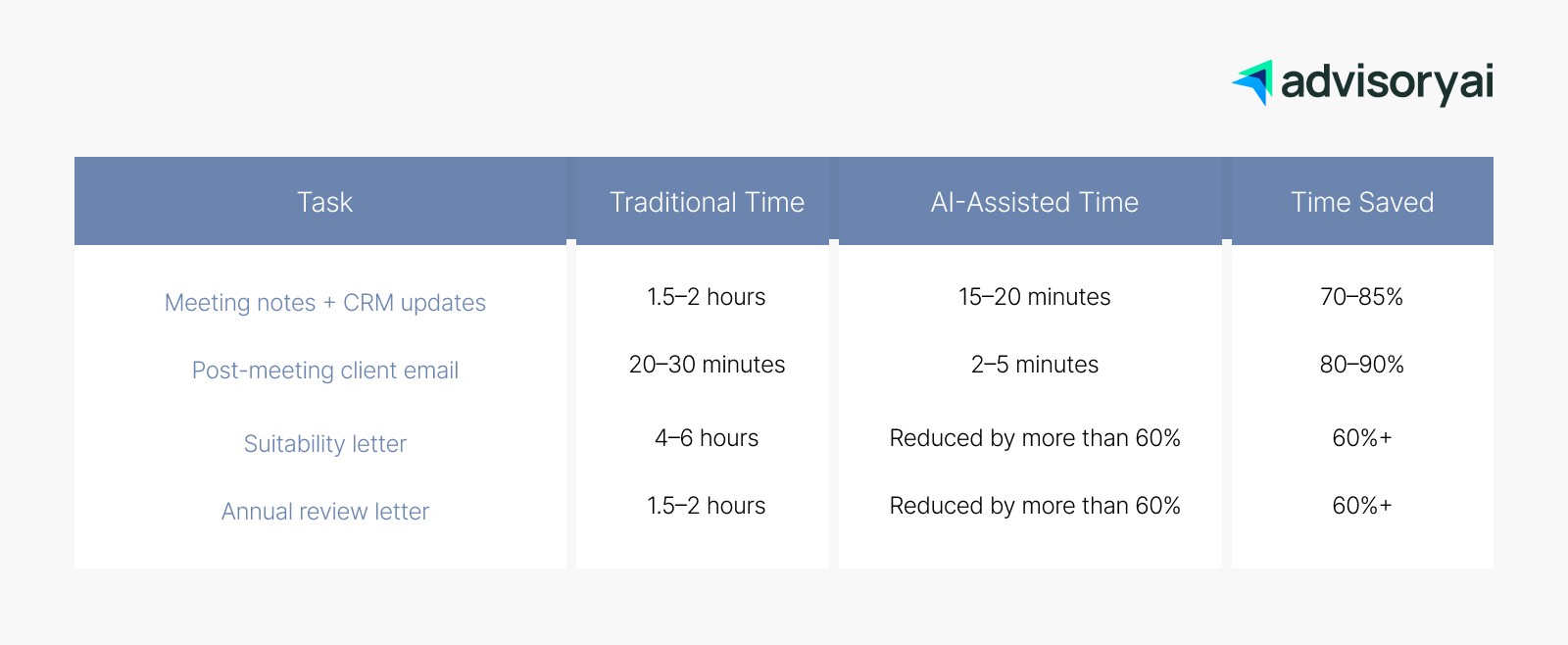
This is where firms reclaim the most capacity per adviser.
Solving the Blockers with Compliance Workflow Automation
NextWealth identified real problems. The question is whether solutions exist today.
Our data says they do, but only in purpose-built compliance automation software.
Data gaps and integration
Emma extracts charges, performance data, objectives, and client circumstances directly from:
Provider illustrations
Fact finds
Meeting notes
Fund factsheets
Risk questionnaires
Two-way CRM integrations with Intelliflo, Plannr, and more CRM platforms remove double-keying entirely.
Every figure and recommendation includes citations back to source documents, allowing instant verification.
Governance and compliance friction
Colin, our compliance checker, doesn’t review reports after they’re written. He checks them during creation.
Emma drafts.
Colin validates against FCA and Consumer Duty requirements in real time.
Issues are flagged with pass/fail verdicts and corrective guidance.
Compliance workflow automation replaces rework cycles with compliance-by-design.
Preventing AI from scaling bad processes
Before training Emma, AdvisoryAI standardises templates:
Structural consistency
FCA-aligned language
Firm-specific tone
Citation frameworks
MI dashboards then highlight weak sections needing frequent edits, allowing continuous process improvement.
Why Suitability Automation Changes Capacity
Meeting notes improve speed.
Suitability reports automation improves capacity.
Advisers working solo typically serve ~73 clients. With paraplanners, that rises to ~120, but only if paraplanners aren’t trapped in 4–6 hour report cycles.
This is why consolidators are leading adoption. Standardised templates plus systematic compliance checking deliver:
Consistent advice quality
Predictable turnaround times
Scalable paraplanner capacity
Audit-ready documentation
Exactly what NextWealth described as the next phase: infrastructure, not tools.
Compliance Automation Software as Competitive Advantage
Leading firms treat compliance as capacity creation.
With AdvisoryAI:
Real-time compliance checking replaces post-hoc audits
Reports are same-day, not multi-day
Pass/fail verdicts come with corrective edits
Full audit trails are generated automatically
When the FCA requests evidence, firms can instantly produce transcripts, notes, reports, citations, and validation records.
Check out how we make this happen:
Why This Matters for Consumer Duty
The FCA’s 2025–2030 strategy makes Consumer Duty ongoing and systematic.
Firms must evidence:
Ongoing suitability
Fair value
Consumer understanding
Good outcomes
Manual compliance makes this burdensome. Embedded compliance automation makes it invisible.
That’s the shift from regulatory constraint to operational strength.
What Firms Should Do Now
Capture meaningful baselines: turnaround time, rework cycles, paraplanner utilisation, adviser capacity
Standardise templates before training AI
Start with meeting notes, then suitability, then scale
Automate inputs, not just outputs
Use compliance automation to eliminate rework
Decide how to reinvest capacity: scale clients, increase touchpoints, or improve advice quality
From Burden to Advantage
Most firms still see compliance as a cost.
When compliance is embedded into workflows, it becomes protection, capacity, and credibility.
That’s the transformation NextWealth identified early. Our data shows it is accelerating.
With AdvisoryAI, compliance automation software is how firms scale advice without compromise.
Ready to see what proper infrastructure looks like?
Book a demo.



BOOK A DEMO